Cups, Grams and Why Serious Bakers Weigh Everything
100 mL of milk is about 0.42 US cups. A cup of flour is 120 g or 150 g depending on how you fill it — density is why volume lies, and why bakers weigh
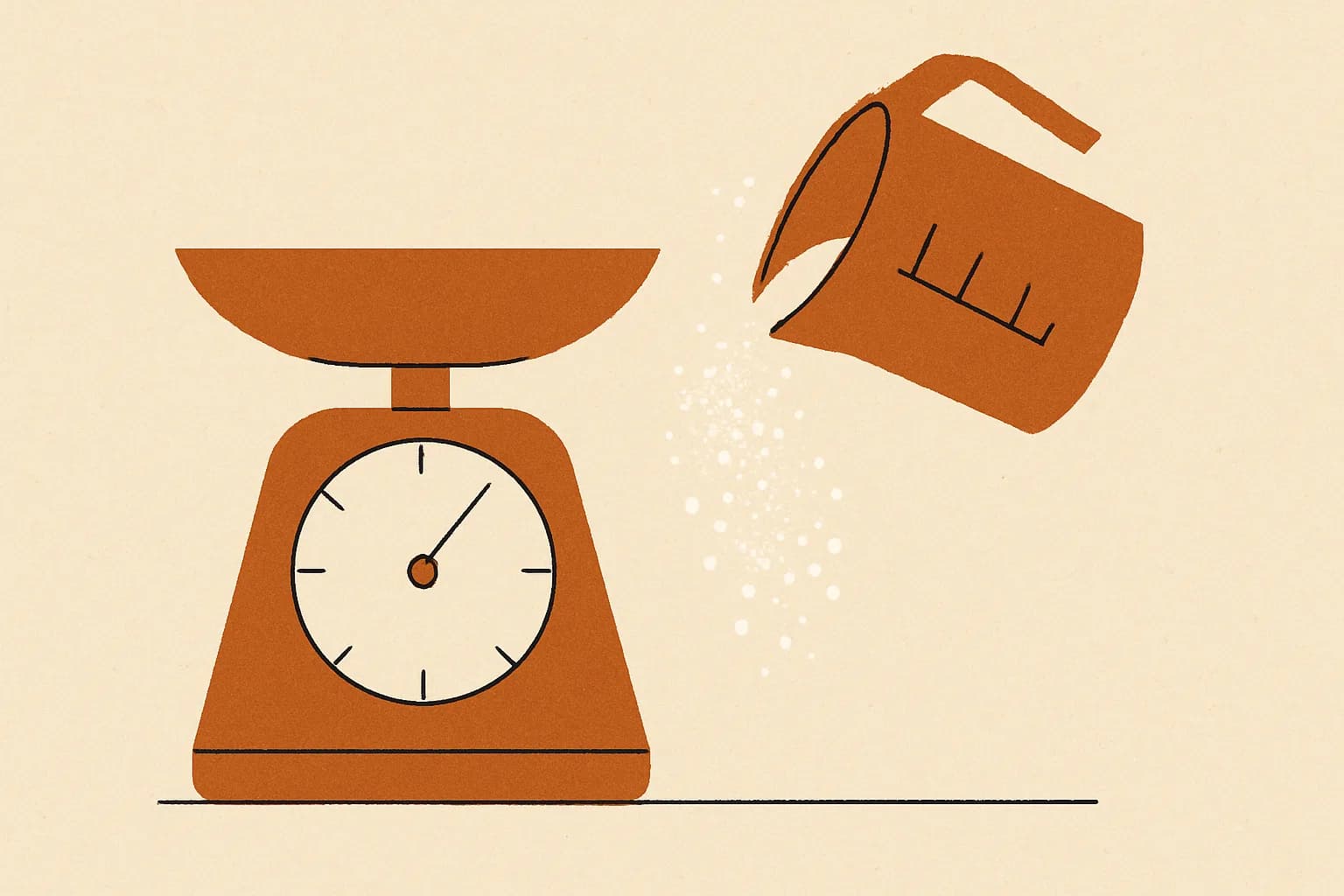
Measured with the cups in an American measuring-cup drawer, 100 mL of milk is 0.42 cups. The US customary cup — the one physical cup sets are calibrated to — is exactly 236.5882365 mL, so 100 ÷ 236.5882365 = 0.4227 cups. The US "legal" cup used on nutrition labels is exactly 240 mL, which gives 100 ÷ 240 = 0.4167 cups. Both round to the same kitchen instruction: a bit over two-fifths of a cup, most easily measured as 6¾ US tablespoons, since 6.75 × 14.7868 mL = 99.81 mL — within a fifth of a milliliter of the target.
If the recipe came from Australia or New Zealand there is a third answer, because the metric cup is exactly 250 mL and 100 ÷ 250 = 0.4 cups even. Three defensible readings of a five-word question is the cup problem in miniature. The milliliters to cups calculator keeps the two US definitions separated, always displaying the legal and customary results side by side, because the gap between them (240 − 236.5882365 = 3.41 mL, about 1.4 percent) is small enough to ignore in one cup of milk and big enough to matter once it compounds through every liquid line of a bread dough.
Milk, though, is the friendly case. Liquids have stable, well-defined densities, so a liquid's volume pins down its quantity completely: 100 mL of milk is the same amount of milk in every kitchen on earth. The conversions that quietly ruin bakes involve dry ingredients, where the cup stops measuring the thing the recipe actually cares about.
Recipes are secretly written in grams
Baking chemistry runs on mass. Hydration, gluten development, the sugar-to-fat balance that decides whether a cookie snaps or bends — all of it is ratios between masses. A measuring cup reads volume, and the only bridge between the two is density:
mass (g) = volume (mL) × density (g/mL)
For a liquid, the density term is a physical constant, which is why cups work fine for milk, water and oil. For a granular solid like flour, "density" includes the air trapped between particles, and that changes with how the cup was filled. The King Arthur Baking Company's Ingredient Weight Chart — the de facto weight standard for American home baking — puts one US cup of all-purpose flour at 120 g when the flour is fluffed, spooned into the cup and leveled. Scoop the cup straight through the bag instead and it compacts to roughly 140 g; pack it down and you reach 150 g. Same cup, same flour, and a 17 to 25 percent spread (140 ÷ 120 = 1.17; 150 ÷ 120 = 1.25). Sifting swings it the other way, leaving each cup 15 to 20 percent lighter than scooped, and flour can even absorb 1 to 2 percent of its own weight from humid summer air.
That spread is why the cooking converter draws a hard line. It converts any volume to any volume and any weight to any weight using exact NIST SP 811 factors, but it refuses cup → gram entirely: without knowing what is in the cup, the conversion has no answer, and a tool that silently assumed water's density would be wrong for nearly everything a baker measures.
Grams to cups, flour: both directions, worked
So what do you do with a European recipe that says 300 g of flour when all you own is cups? Divide by the spoon-and-level weight: 300 ÷ 120 = 2.5 cups of all-purpose flour — with the technique attached. Fluff the flour with a fork, spoon it into a dry-measure cup without compacting, level it with a straight edge. Skip the technique and scoop those 2.5 cups straight from the bag at about 140 g each and you have actually added 2.5 × 140 = 350 g, a 50-gram overshoot (350 − 300 = 50, or 17 percent) on the one ingredient that controls the crumb.
The reverse direction fails harder. An American recipe calling for 3 cups of flour means 3 × 120 = 360 g under the convention its writer used. Measured as packed cups it becomes 3 × 150 = 450 g: a surplus of 90 g, which is 90 ÷ 120 = 0.75 — three-quarters of a cup the recipe never asked for, a 25 percent overshoot (450 ÷ 360 = 1.25). That is the distance between a tender biscuit and a dense one, and it happens to careful cooks, because nothing about a firmly scooped cup looks wrong.
One cup, eight different weights
If flour's packing were the whole problem, a single correction factor would patch it. The deeper problem is that every ingredient sets its own exchange rate between cups and grams. From the King Arthur chart, one US cup holds:
| Ingredient (1 US cup) | Weight (g) | Implied density (g/mL) |
|---|---|---|
| Whole-wheat flour | 113 | 0.48 |
| Cake flour | 116 | 0.49 |
| All-purpose flour | 120 | 0.51 |
| Granulated sugar | 198 | 0.84 |
| Brown sugar, packed | 213 | 0.90 |
| Butter | 227 | 0.96 |
| Water | 236.6 | 1.00 |
| Honey | 340 | 1.44 |
The density column is just each weight divided by the cup's 236.588 mL. Read down it and the scale of the problem is obvious: the same physical cup holds three times the weight of honey as of whole-wheat flour (340 ÷ 113 = 3.0), and no two rows share a factor. "Grams to cups" is never one conversion — it is one conversion per ingredient, per filling method.
Cooking doesn't stabilize the cup either
The cup stays unreliable even after the measuring is done. USDA publishes two fully independent measurements of what boiling does to spaghetti, and by weight they agree remarkably well: the Food Buying Guide measured 1 lb of dry spaghetti yielding 2.37 lb cooked, and FoodData Central's composition records — dry pasta 9.90 percent water, cooked pasta 62.13 percent — imply that 100 g of dry pasta, carrying 90.10 g of dry matter, must cook up to 90.10 ÷ 0.3787 = 237.9 g, a factor of 2.379. Different programs, different methods, 0.4 percent apart.
By volume the agreement collapses. USDA's food-service convention packs cooked spaghetti into a spooned, leveled measure at about 205 g per cup, while FoodData Central's loosely filled household cup holds 124 g — the packed cup carries about 65 percent more ((205 − 124) ÷ 124 = 0.65) of the very same pasta. Weight replicates across institutions; a cup cannot even replicate across cups. That is why the dry to cooked pasta calculator answers in grams first and labels its cup figures as the packed food-service kind rather than pretending one cup count fits every kitchen.
What baking by weight actually buys you
Baking by weight is not a professional affectation; it removes every ambiguity above at once. A gram is a gram regardless of who measured it, which cup they own, whether the flour was sifted, and which country's spoons the recipe meant — an Australian tablespoon is a 20 mL national standard against the US's 14.7868 mL, a mismatch that grams never see. America's Test Kitchen prints weights beside volumes and points readers to the weight column wherever texture matters; Modernist Cuisine declines to print volumes for dry ingredients at all. The equipment cost is a roughly $15 digital scale, and the workflow is faster than cups, not slower: bowl on the scale, tare, pour flour to 120, tare, pour sugar to 198. Nothing to level, nothing extra to wash, and scaling a batch to 1.5× becomes plain multiplication instead of an argument with three-quarters of a third of a cup.
None of this means abandoning cup-based recipes — it means knowing which conversions are safe. Volume to volume is pure arithmetic and always safe, which is why the converters on Quanta are built to show the divisor they used, not just the answer. Volume to weight is only safe through a stated density and a stated filling method: King Arthur's chart for baking, USDA's FoodData Central for nearly everything else. The habit that ties it all together costs nothing: the first time you weigh a cup measurement you trust, write the grams in the recipe's margin. Do that for a season and your notebook becomes its own density chart, calibrated to your flour, your cups and your kitchen's humidity. For an ingredient the published charts leave unsettled, the contact page is open; state the filling method up front, since every density answer starts there.