Roman Numerals: The Rules, the Exceptions, and Why MCMXCIX Isn't MIM
The seven symbols, the six legal subtractive pairs, why 1999 is MCMXCIX rather than MIM, and the clock-face IIII that breaks the rules on purpose
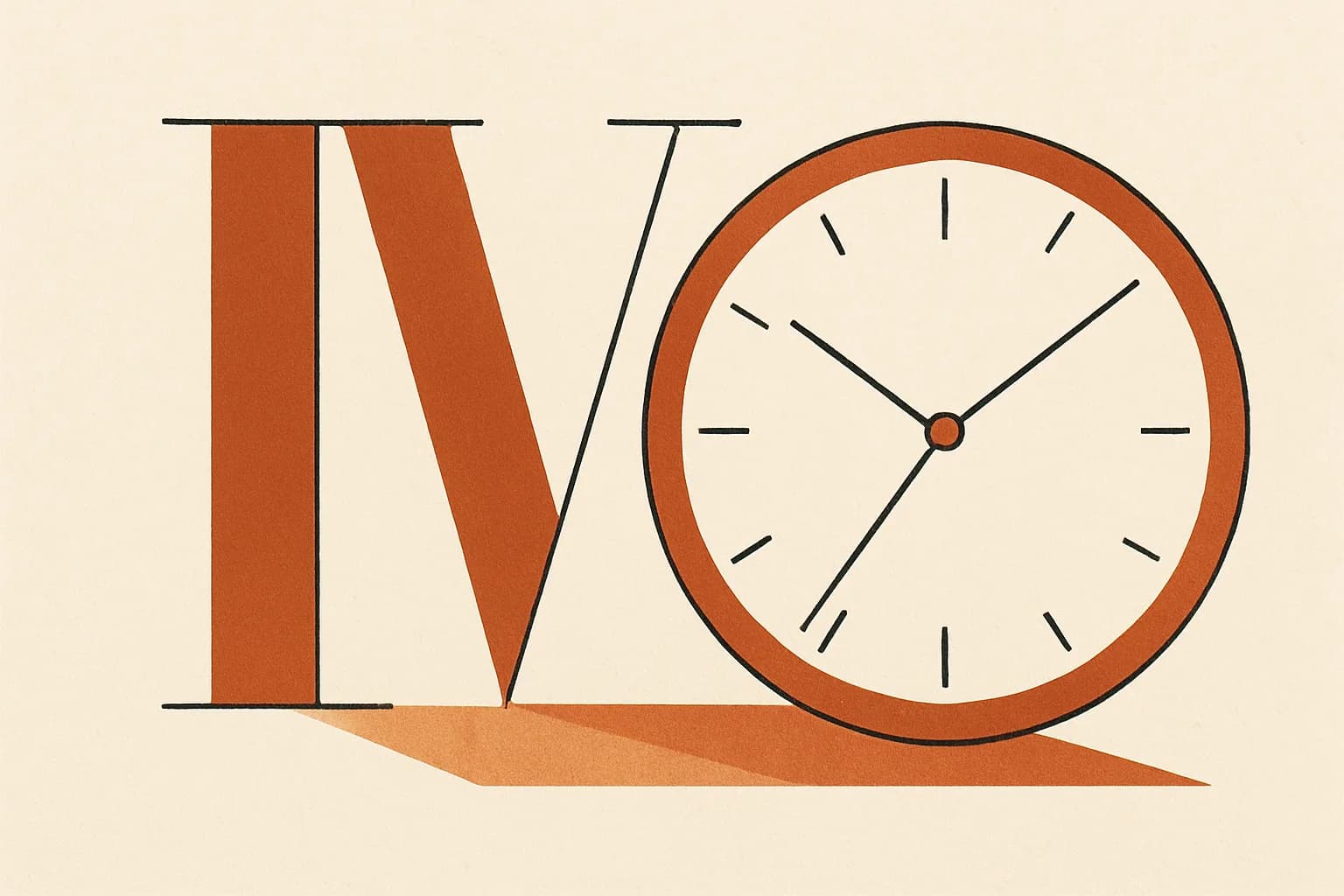
The rules of Roman numerals fit in four sentences. Seven letters carry fixed values: I = 1, V = 5, X = 10, L = 50, C = 100, D = 500 and M = 1,000. You read left to right and add — unless a smaller symbol sits directly before a larger one, in which case it subtracts, and only six such pairs are legal: IV (4), IX (9), XL (40), XC (90), CD (400) and CM (900). A power-of-ten symbol (I, X, C, M) repeats at most three times in a row; the five-based symbols V, L and D never repeat at all. The system covers the whole numbers from 1 to 3,999 — no zero, no negatives, no fractions.
That is the complete modern convention. Everything below is those four sentences unpacked: what "reads left to right" means mechanically, why exactly six subtractions made the cut, what happens digit by digit when you encode a year like 1999, and the one famous place — the clock face — where the rulebook is ignored on purpose.
Addition is the default
| Symbol | Value |
|---|---|
| I | 1 |
| V | 5 |
| X | 10 |
| L | 50 |
| C | 100 |
| D | 500 |
| M | 1,000 |
Most numerals are pure addition. VIII is 5 + 1 + 1 + 1 = 8. MMXXVI — the default example in the Roman numerals converter — is 1,000 + 1,000 + 10 + 10 + 5 + 1 = 2,026. Notice the discipline hiding in plain sight: symbols appear in non-increasing order of value, biggest first. The moment that order breaks — a smaller symbol placed before a bigger one — the smaller symbol flips sign. That single mechanic is the entire parsing rule:
value = Σ (each symbol's value — added, unless the symbol is smaller than the one immediately after it, in which case it is subtracted)
Run that over MCMXCIX and you get 1,000 − 100 + 1,000 − 10 + 100 − 1 + 10 = 1,999.
Only six subtractions are legal
The subtraction mechanic is deliberately caged. Left unrestricted, it would let almost every number wear several spellings, and the notation would stop being checkable. The modern convention allows precisely these pairs:
| Pair | Arithmetic | Value |
|---|---|---|
| IV | 5 − 1 | 4 |
| IX | 10 − 1 | 9 |
| XL | 50 − 10 | 40 |
| XC | 100 − 10 | 90 |
| CD | 500 − 100 | 400 |
| CM | 1,000 − 100 | 900 |
Three restrictions generate that table. Only the power-of-ten symbols I, X and C may subtract — never V, L or D. Each may subtract only from the two symbols immediately above it: I from V or X, X from L or C, C from D or M. And a subtractive prefix appears exactly once — IIX is not 8 (write VIII), and XXC is not 80 (write LXXX, which is 50 + 10 + 10 + 10).
These restrictions kill the "clever" spellings people invent. IL is not 49, because I may not subtract from L; forty is XL and nine is IX, so 49 is XLIX (40 + 9). VX is not 5, because V never subtracts. And IM is not 999 — which brings us to the year this post exists to explain.
Why 1999 is MCMXCIX and not MIM
Here is the observation that makes the whole system click: canonical Roman numerals encode each decimal digit separately. The thousands, hundreds, tens and units of a number each get their own block of symbols, and subtraction never reaches across a place boundary.
| Place | Digit | Block | Arithmetic |
|---|---|---|---|
| Thousands | 1 | M | 1,000 |
| Hundreds | 9 | CM | 1,000 − 100 = 900 |
| Tens | 9 | XC | 100 − 10 = 90 |
| Units | 9 | IX | 10 − 1 = 9 |
Concatenate the blocks and you have MCMXCIX: 1,000 + 900 + 90 + 9 = 1,999.
MIM fails this structure twice over. Read purely as sign-flipping arithmetic it does total 1,000 + (1,000 − 1) = 1,999 — that is what makes it tempting, and at three characters against MCMXCIX's seven it looks like a bargain. But I is only permitted to subtract from V or X, and "IM" would be a single pair reaching from the units place all the way into the thousands, smearing three place boundaries in one step. Compactness was never the design goal; a unique, checkable spelling for every number was. Under the canonical rules there is exactly one way to write 1,999, and MIM is not it.
This uniqueness is also how a strict converter validates input without keeping a blacklist of bad strings. The tool parses your Roman numeral with the sign-flip rule, then re-encodes the total canonically — walking the ordered token list M, CM, D, CD, C, XC, L, XL, X, IX, V, IV, I and taking each token as many times as it still fits — and accepts the input only if the round trip reproduces it exactly. MIM parses to 1,999, re-encodes to MCMXCIX, fails the match, and is rejected.
Repetition: three in a row, and never V, L or D
The repetition limits follow from the same one-spelling-per-number principle. VV would just duplicate X, LL would duplicate C, and DD would duplicate M — so the five-based symbols never repeat. A fourth repeat of a power of ten is always expressible as a subtractive pair instead: XXXX gives way to XL, CCCC to CD.
One consequence surprises people used to fixed-width digits: canonical numerals have wildly uneven lengths. 888 comes out as DCCCLXXXVIII — 500 + 300 + 80 + 8, twelve characters — because every one of its digits lands at the awkward "a five plus three repeats" point. Two steps away, 890 collapses to DCCCXC, six characters. The longest numeral in the whole supported range belongs to 3,888: MMMDCCCLXXXVIII (3,000 + 800 + 80 + 8), fifteen characters for a four-digit number.
The clock-face IIII
Walk past enough old public clocks and you will find dials marking four o'clock IIII instead of IV — a straight violation of the subtractive convention, applied deliberately and consistently for centuries. Additive IIII is not a modern error, either: it appears in ancient inscriptions from eras before the subtractive style hardened into the single form taught today.
The explanation most often offered for the dials is visual balance: IIII sits directly opposite VIII on the face, giving those mirrored positions equal four-character weight, and it keeps the first four hour markers built from I-strokes alone before V debuts at five. Whether any particular clockmaker truly reasoned that way is harder to establish than the pattern itself — the honest summary is that IIII is a surviving convention, not a mistake.
For anyone transcribing rather than converting, the practical rule is the one the converter's own documentation gives: preserve the artifact's spelling. A strict tool rejects IIII by design, because its job is to define the modern canonical form — not to claim that every object in history followed it.
What the rules cannot write
The canonical system has hard edges. There is no zero — later writers sometimes used N, for nulla, but it was never part of the classical notation. There are no negatives and no standard fractions. Above 3,999, the plain seven-letter alphabet runs out: MMMM would break the three-repeat rule, and the historical workarounds — overlines that multiply a symbol by 1,000, enclosing marks, or simply stacking more Ms — were never standardised consistently enough to survive plain-text typing. That is why the Roman numerals calculator runs from 1 to 3,999, topping out at MMMCMXCIX: 3,000 + 900 + 90 + 9 = 3,999.
Those edges mark what the notation was for: labelling, not arithmetic. Kings, chapters, hours and cornerstones get counted; nothing gets multiplied. With no zero and no place value, Roman numerals survive as ceremony — and converting them is the rare conversion with no units attached, just one integer in two costumes, which is why this tool lives among the unit converters on Quanta. One last practical note: Roman numerals get carved, engraved and tattooed, which makes them unusually expensive to get wrong. Before a date goes anywhere permanent, run it through the converter in both directions — and if you are still torn between canonical IV and a clockmaker's IIII for your own project, ask us first. Stone is a bad place to discover the difference.