USDA Food Yields: Why Recipes Measure Before and After Cooking
What USDA food yields measure, why cooked and raw weight are different numbers, and the double-counting mistake that oversizes every holiday turkey
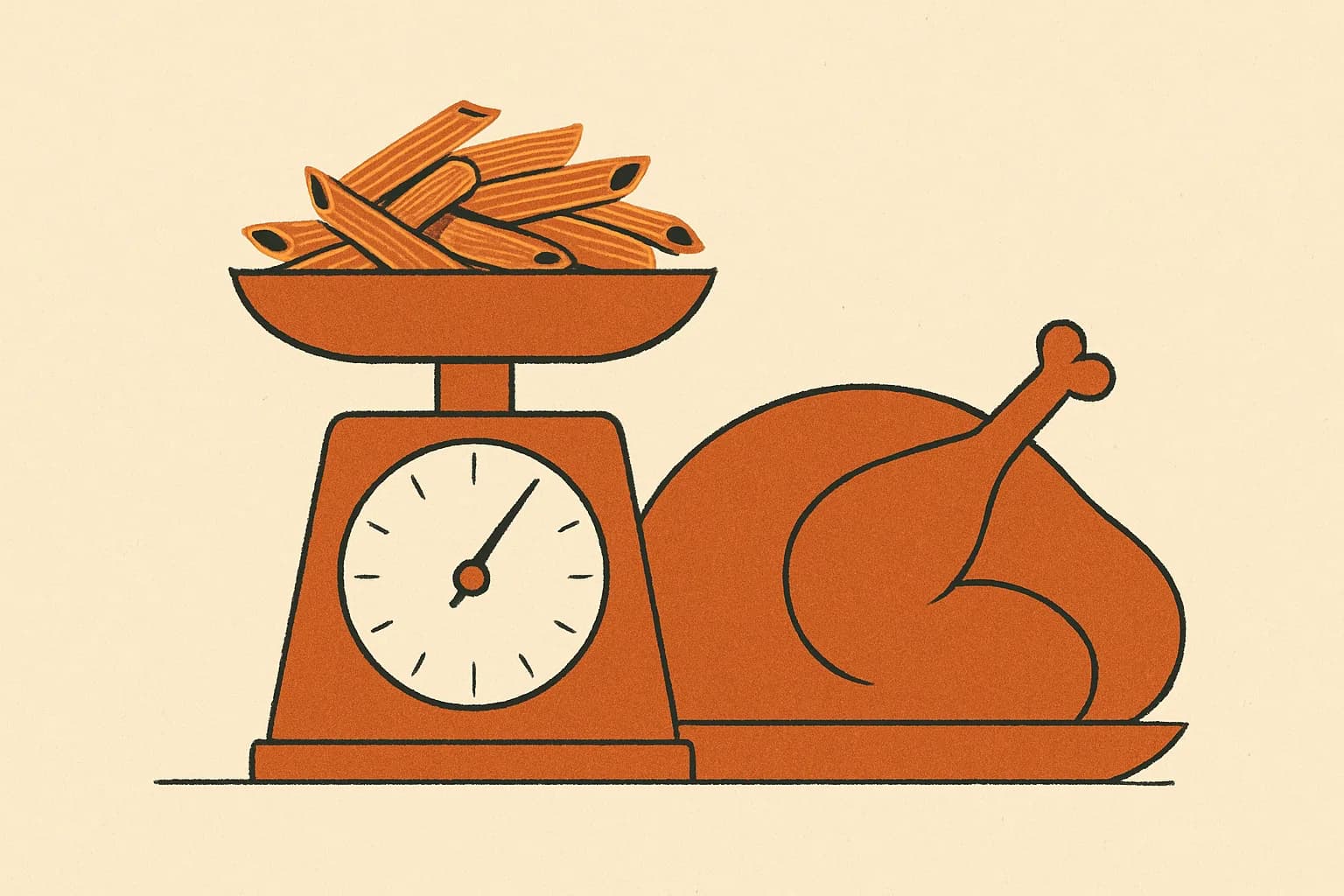
USDA food yields are before-and-after measurements: what a pound of food, exactly as it is sold, becomes by the time it is cooked and ready to serve. The USDA Food and Nutrition Service publishes them as yield tables in the Food Buying Guide for Child Nutrition Programs — the reference school kitchens use to purchase food for millions of meals a day — and every row is a measured statement rather than an estimate. One pound of dry enriched spaghetti boils up to 2.37 pounds of cooked pasta. One pound of whole turkey bought with its neck and giblets roasts down to 0.48 pounds of cooked meat. That ratio is the yield factor, and it is the number connecting the weight on the shop scale to the weight on the plate.
It is also the whole reason recipes have to say which side of the stove their weights come from. Cooking moves water — into pasta, rice and beans, out of meat and poultry — so the raw and cooked weights of the same food are genuinely different numbers, different by a factor of two or three in either direction. "200 g of pasta" is not one instruction but two, depending on whether the pasta has been boiled yet, and the gap between the two readings is far too wide to split by guessing. USDA measured the ratios so nobody has to.
The rule doing all the work: dry matter survives cooking
Beneath nearly every row of the yield tables sits one piece of bookkeeping — water moves, substance stays:
cooked weight = raw weight × yield factor, where the factor is set by how much water moved in or out
Pasta shows how tightly that rule holds. USDA's FoodData Central lists dry enriched pasta at 9.90 g of water per 100 g and cooked pasta at 62.13 g per 100 g. Turn both around: 100 − 9.90 = 90.10 g of dry matter goes into the pot with every 100 g of pasta, and each 100 g coming out carries 100 − 62.13 = 37.87 g of it. Boiling adds water and removes nothing, so 100 g dry must emerge as 90.10 ÷ 0.3787 = 237.9 g cooked — a factor of 2.379. The Food Buying Guide got its spaghetti figure the other way entirely, with a scale and a pot, and published 2.37. Two USDA programs, two unrelated methods, and the answers differ by (2.379 − 2.37) ÷ 2.37 ≈ 0.4%. The dry to cooked pasta calculator runs those published per-shape factors in both directions — dry weight to cooked, or a recipe's cooked target back to what to take out of the box.
Meat obeys the same conservation, pointed the other way. Water leaves as oven drip and steam, and the purchase weight also carries parts that never reach a plate — neck, giblets, bone, fat — which is why poultry factors sit far below 1 and swing hard by cut.
Gainers and losers, from the same tables
| USDA yield row | Factor (per lb raw) | Condition measured |
|---|---|---|
| Spaghetti, enriched | 2.37× | al dente, 8-minute boil |
| Bowties (farfalle), large | 2.66× | 17-minute boil |
| Orzo | 3.07× | 14-minute boil |
| Whole turkey, with neck and giblets | 0.48× | roasted; skin eaten |
| Whole turkey, without neck and giblets | 0.53× | roasted; skin eaten |
| Turkey breast, bone-in | 0.64× | roasted; skin eaten |
| Turkey leg quarters, bone-in | 0.53× | roasted; skin eaten |
Two patterns are worth reading off the table. On the pasta side, the factor tracks the clock as much as the shape: USDA measured spaghetti al dente at 8 minutes and bowties after 17, and pasta keeps drinking for as long as it boils — cook a shape past its measured time and the true factor climbs above the published one. On the turkey side, the spread is anatomy. A bone-in breast has no carcass, legs or wings to lose, so it yields 0.64 where a whole bird with giblets manages 0.48. And every poultry row is published twice, with and without skin: decline the skin on that whole bird and 0.48 falls to 0.42 — a difference of 0.06 lb of food per pound bought, an eighth of the with-skin yield.
AP and EP: the two weights on either side of the oven
The Food Buying Guide's own vocabulary for the two sides is worth adopting: as purchased (AP), the label weight with everything still attached, and edible portion (EP), what reaches plates. Planning always runs from EP backwards. Ten guests at 8 oz of cooked turkey each need 10 × 8 = 80 oz, which is 80 ÷ 16 = 5 lb EP; at the whole-bird-with-giblets yield that means buying 5 ÷ 0.48 = 10.42 lb AP. Divide through and it is 10.42 ÷ 10 = 1.04 lb per person — the familiar "pound of turkey per head," derived instead of recited. The rule was never about turkeys; it is a statement about an 8 oz serving pushed through a 0.48 yield, which is why it fails the moment the cut changes. The turkey size calculator runs this chain for four cuts, with and without skin.
The AP definition carries the tables' most common misreading: buying extra "to allow for the bones." Every loss between shop and plate is already inside the factor — bones, giblets, drip, evaporation — so padding the purchase counts the same loss twice. It is how careful cooks end up with birds two sizes too large.
The turkey rows also permit a satisfying audit. USDA prints each yield a second time, as a servings column, and on the whole-bird row the two match exactly: 0.48 × 16 = 7.68 one-ounce servings per pound bought, just as tabulated. Better still, University of Nebraska–Lincoln Extension publishes two rules of thumb it never connects — a pound of whole bird per person, three-quarters of a pound of bone-in breast — and USDA's independent yields reconcile them: 1.00 × 0.48 = 0.48 lb and 0.75 × 0.64 = 0.48 lb of cooked meat. Both rules quietly describe the same 7.68 oz plate.
Why yields are written in weight and never cups
The spaghetti row demonstrates the reason. One pound of dry spaghetti is 453.59237 g, so USDA's cooked figure is 453.59237 × 2.37 = 1,075 g — which the guide measures as 5.30 cups, spooned and leveled into a ¼-cup portioning measure. That is 1,075 ÷ 5.30 = 203 g per cup. FoodData Central, weighing the same food, lists a loosely filled household cup of cooked spaghetti at 124 g. Both figures are correct, because a cup measures space rather than food, and how much food occupies the space is technique. Weight carries no packing convention, which is why every factor in the yield tables is a mass ratio. It is also why the cooking converter happily converts cups to milliliters — a US cup is 236.588 mL of space — but refuses cup-to-gram outright: crossing from volume to weight needs a density, and density is precisely what a cup does not pin down.
Three ways the before/after distinction bites
Recipes. Read "200 g pasta" as cooked when the author meant dry and you make 200 g of food where 200 × 2.37 = 474 g was intended — the dish arrives at well under half strength.
Food logs. FoodData Central lists cooked enriched pasta at 158 kcal per 100 g. Since 100 g dry becomes 237.9 g cooked, the same entry read against dry pasta is 158 × 2.379 = 376 kcal per 100 g. A tracker entry that omits the cooked/raw state can be wrong by a factor of 376 ÷ 158 = 2.38.
Borrowed factors. USDA publishes cooked-weight yields for eight enriched semolina pasta shapes and none for whole-wheat or gluten-free versions, which absorb water differently; the turkey table has no row for boneless breast. Where USDA declined to guess, applying a neighboring food's factor manufactures a number nobody measured — and the calculators above leave those options out for exactly that reason.
A yield factor is a single multiplication; everything that matters is where the constant came from. That is the standard Quanta holds its food tools to: the pasta and turkey calculators show the USDA yield doing the work right beside the result, cite the exact row it came from, and decline to answer for foods whose yield USDA never published — elbow macaroni on the pasta side, boneless breast on the turkey side — rather than dress a borrowed factor up as a measurement. Those refusals are honest, not permanent; a request through the contact page naming a specific food is what moves its published yield up the list of constants worth chasing down. Until a food makes that list, the workaround is USDA's own method scaled to a single kitchen: cook one test batch, weigh both sides of the pot, and write the resulting factor on the recipe card — along with which side of the stove it belongs to.