Parallax: How We Measure the Distance to Stars
The parallax distance formula d = 1/p explained — why the parsec makes it exact, worked examples from real catalogues, and the 20% rule for Gaia-era parallaxes
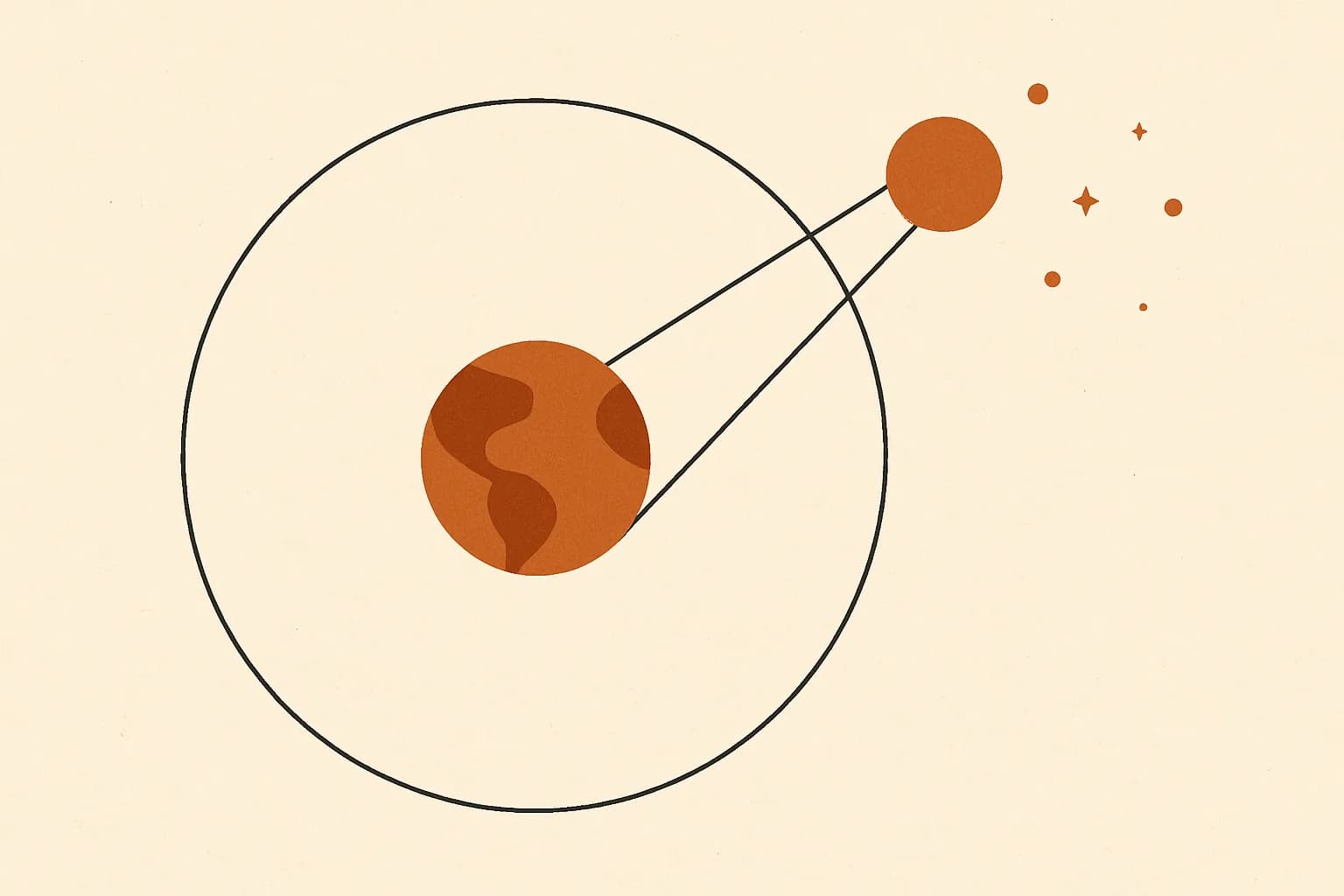
The parallax distance formula is a single reciprocal with no constants in it:
d (parsecs) = 1 ÷ p (arcseconds) — or, because modern catalogues publish parallax in milliarcseconds, d (pc) = 1000 ÷ p (mas)
Here p is the star's annual parallax — half the total angular shift a nearby star appears to make against far more distant background stars as the Earth swings from one side of its orbit to the other. Measure that angle in arcseconds, take its reciprocal, and the result is the distance in parsecs. Want light-years instead? Multiply the parsec figure by 3.2615637772, the exact conversion ratio.
That is everything the formula asks of you, but its bareness deserves a moment of suspicion: physical relationships usually drag constants along, and this one has none. The reason is that the parsec was invented specifically to absorb them — and knowing that is the difference between memorizing d = 1/p and actually trusting it.
The parsec is a definition, not a discovery
A parsec — the word contracts "parallax arcsecond" — is defined as the distance at which one astronomical unit (the Earth–Sun distance, which supplies the baseline for the whole measurement) subtends an angle of exactly one arcsecond. IAU 2015 Resolution B2 pins the unit down: 1 pc = 648,000/π astronomical units, which evaluates to 206,264.806247 au — the number of arcseconds in a radian, as it must be for the geometry to close.
Two things follow. First, d = 1/p is exact by construction rather than a small-angle approximation, even though it is often taught as one: the small-angle step lives inside the unit's definition, so the inversion itself adds no error, and every scrap of uncertainty in the distance walked in with the measured parallax. Second, this convenience is the entire reason professional astronomy prefers parsecs to light-years — with parallax data, no conversion constant is needed at all.
Proxima Centauri, worked in arcseconds
The nearest star to the Sun carries the largest stellar parallax ever measured, which makes it the cleanest possible example. SIMBAD lists Proxima Centauri's parallax as 768.0665 ± 0.0499 mas, from the Gaia Early Data Release 3 catalogue.
- Convert to arcseconds: 768.0665 ÷ 1000 = 0.7680665″.
- Invert: d = 1 ÷ 0.7680665 = 1.3019706 parsecs.
- Convert the unit if needed: 1.3019706 × 3.2615637772 = 4.2464601 light-years.
Two divisions and a multiplication turn one measured angle into the familiar "4.25 light-years to the nearest star." Pause on how small that angle is: 0.7680665 arcseconds, where an arcsecond is 1/3600 of a degree — and this is the largest one there is. No star has a parallax of a full arcsecond, which is simply another way of saying no star sits within one parsec of the Sun.
Running a second star shows the formula holding at longer range. Van Leeuwen's 2007 Hipparcos re-reduction gives Sirius a parallax of 379.21 ± 1.58 mas: d = 1000 ÷ 379.21 = 2.63706 pc, and 2.63706 × 3.2615637772 = 8.60094 — the well-known 8.6 light-years. The parallax distance calculator executes exactly these steps and adds the outputs that are tedious by hand: astronomical units, kilometers, the distance modulus that photometry needs, and the 1σ distance range implied by the catalogue's error bar.
Where the numbers come from now
Ground-based astrometry could measure trustworthy parallaxes out to a few tens of parsecs. The Hipparcos satellite stretched that to a few hundred. Gaia now measures parallaxes across the Milky Way — and publishes them, like Hipparcos and SIMBAD, in milliarcseconds, because arcsecond-scale parallaxes essentially do not exist among real stars.
Gaia-era precision cut both ways, though: it exposed how much the astrometric solution matters. α Centauri is the cautionary tale. The original Hipparcos catalogue put its parallax near 742 mas; van Leeuwen's 2007 re-reduction moved it to 754.81 ± 4.11 mas; Pourbaix and Boffin's 2016 orbit-aware solution brought it back to 743 ± 1.3 mas. The spread is 754.81 − 742 = 12.81 mas, and 12.81 ÷ 742 = 1.7% — several times any single quoted error bar, for the Sun's nearest neighbouring system. A parallax is the output of a solution with a provenance, not a raw fact. Record which catalogue and which data release yours came from.
The 20% rule, and why error bars go lopsided
Every catalogue parallax comes with an uncertainty σ, and the one number that decides whether d = 1/p can be trusted is the fractional uncertainty σ/p. For Proxima it is 0.0499 ÷ 768.0665 = 0.0065%, superb. For Sirius, 1.58 ÷ 379.21 = 0.42%, still excellent. But most of what Gaia catalogues is faint and distant, and there the picture changes. Take a star measured at 1 ± 0.2 mas — a fractional uncertainty of 0.2 ÷ 1 = 20%:
| Parallax used | Arithmetic | Distance |
|---|---|---|
| Central value, 1.0 mas | 1000 ÷ 1.0 | 1000 pc |
| Larger parallax, p + σ = 1.2 mas | 1000 ÷ 1.2 | 833 pc — near end |
| Smaller parallax, p − σ = 0.8 mas | 1000 ÷ 0.8 | 1250 pc — far end |
The error bar on the parallax was symmetric; the one on the distance is not. The near end sits 1000 − 833 = 167 pc below the central value while the far end sits 1250 − 1000 = 250 pc above it, because 1/p is a convex function and stretches the small-parallax side of the interval. Bailer-Jones (2015, PASP 127) showed that once σ/p passes roughly 20%, naive inversion stops being a defensible distance estimate at all and must give way to a Bayesian estimate with an explicit distance prior — and he noted that roughly 80% of the stars Gaia would catalogue fall past that threshold. Gaia even publishes negative parallaxes for very faint sources; those are noise excursions around a tiny true value, not stars at negative distances. This is why the calculator computes σ/p on every input, prints the asymmetric range instead of a tidy ± figure, and says plainly which regime your answer is in.
One angle, holding up everything above it
Parallax is the only direct, geometric distance measurement astronomy has, which makes it the bottom rung of the cosmic distance ladder: Cepheid period–luminosity relations, the tip of the red giant branch, Type Ia supernovae and ultimately the Hubble constant are all calibrated, rung by rung, on geometric parallaxes of nearby stars. That is why the systematics above earn a whole section — an error at the bottom rung propagates all the way up.
The distance also transforms everything else known about a star. Apparent brightness plus distance yields true luminosity, and luminosities of stars with directly measured masses — detached eclipsing binaries — are what calibrate the empirical mass–luminosity relation. That relation in turn drives the star lifetime calculator: because luminosity climbs so steeply with mass, dividing a star's nuclear fuel by its burn rate gives the Sun roughly 10.4 billion years on the main sequence while a ten-solar-mass star gets about 33 million. One measured angle, inverted, ends up underpinning how long we think stars live.
Parallax rewards a specific kind of care rather than a large amount of it: record which catalogue and data release the number came from, keep milliarcseconds and arcseconds straight, and look at σ/p before believing any inverted distance. Those three habits are precisely what the calculators on Quanta automate — cheap insurance on a measurement whose entire uncertainty budget arrives with the input angle. Questions about a stubborn catalogue value, or a distance that refuses to match a published one, can go to the contact page; in the meantime, every figure in this walkthrough sits one reciprocal away from being checked by hand.