Watts, Amps and Volts: The Household Electricity Triangle
How volts, amps and watts relate, how to convert watts to amps at any voltage, and why breakers trip on current while your bill only counts power
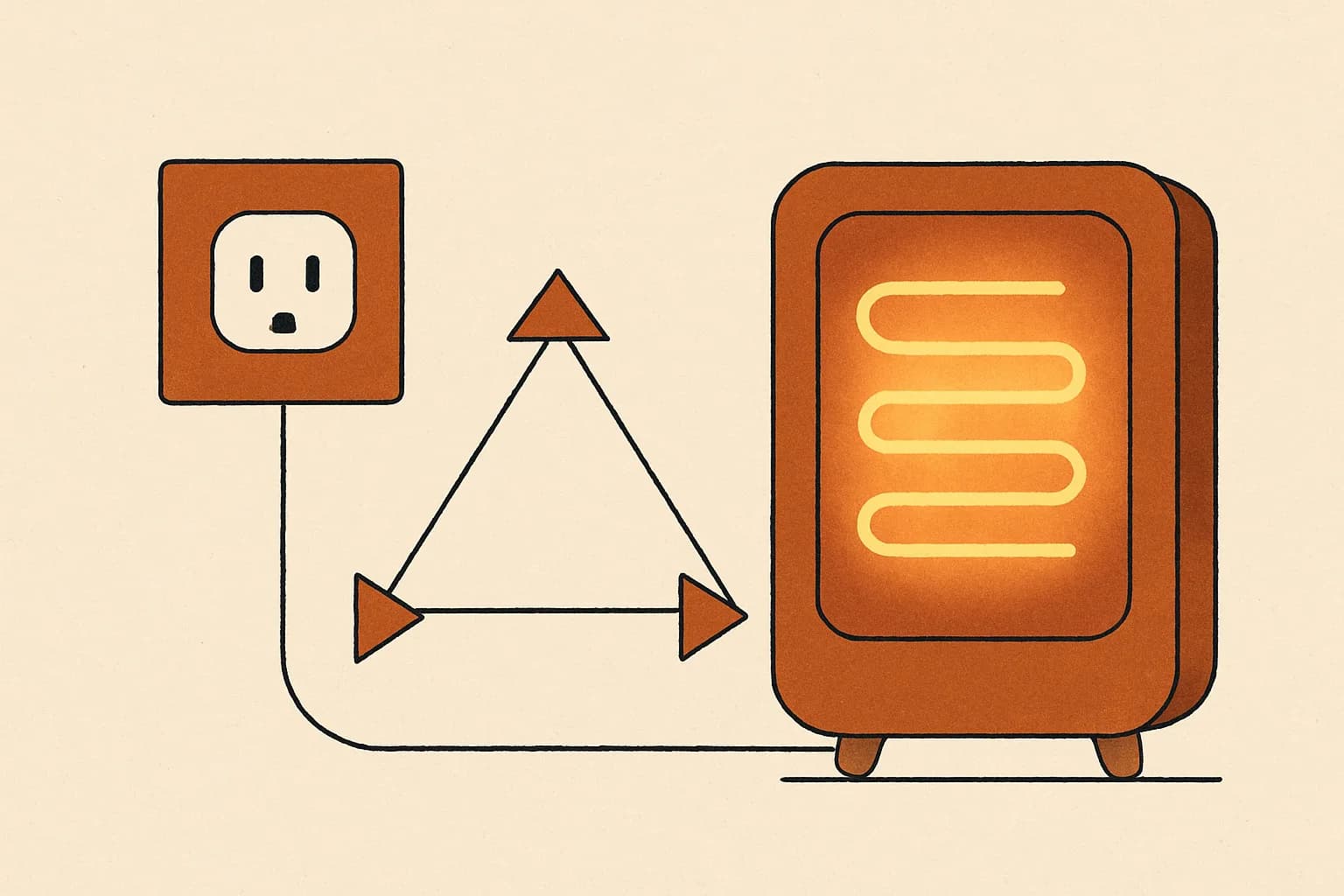
Converting watts to amps takes one division: current equals power divided by voltage. A space heater with 1,500 W on its nameplate, plugged into a 120 V outlet, draws 1,500 ÷ 120 = 12.5 A. A heater built to deliver the same 1,500 W from a 240 V supply draws 1,500 ÷ 240 = 6.25 A — identical heat, carried by half the current. That is the whole conversion for anything that simply gets hot: heaters, kettles, toasters, incandescent bulbs. The watts to amps calculator runs it in any direction on DC, single-phase and three-phase supplies.
One refinement completes the picture: on AC, a load with a motor or electronics inside pulls its current out of step with the voltage, and the honest division becomes I = P ÷ (V × PF), where PF is the power factor, a decimal between 0 and 1. For resistive appliances PF is 1 and the term vanishes. The rest of this guide unpacks one relationship:
P = V × I — power (watts) equals voltage (volts) times current (amps). Rearranged for current: I = P ÷ V on DC, and I = P ÷ (V × PF) on household AC.
Volts push, amps flow, watts work
The three units answer three different questions. Voltage is the electrical pressure the supply holds ready, and it is fixed before you plug anything in: 120 V or 230 V at the wall depending on the country, 12 V across a car battery, 5 V at a USB socket. Current is the rate at which charge moves once a load completes the circuit — and it is what the copper in your walls feels, since conductors heat according to amps, not watts. Power is the rate at which useful work gets done, and it is what the utility meter bills: a 1.5 kW heater consumes 1.5 kilowatt-hours for every hour it runs.
The triangle is rigid — fix any two quantities and the third is decided. In a house, the grid fixes the volts and each appliance's design fixes its watts, so the amps are the one number nobody chooses directly — and the only one the breaker panel polices.
How many amps is 100 watts?
On a standard 120 V outlet, a 100 W load draws 100 ÷ 120 = 0.83 A. But the question has no single answer, because the voltage sets the exchange rate:
| Supply | Arithmetic | Current (PF = 1) |
|---|---|---|
| 240 V outlet | 100 ÷ 240 | 0.42 A |
| 230 V outlet | 100 ÷ 230 | 0.43 A |
| 120 V outlet | 100 ÷ 120 | 0.83 A |
| 12 V battery | 100 ÷ 12 | 8.33 A |
| 5 V USB | 100 ÷ 5 | 20 A |
The same 100 W spans a nearly fifty-to-one range of current (20 ÷ 0.42 ≈ 48). The middle rows show the rule at its cleanest: dropping from 120 V to 12 V — a factor of 120 ÷ 12 = 10 — multiplies the current by exactly the same factor of ten. Low voltage does not mean gentle wiring; it means the opposite.
The nameplate and the breaker
A breaker is rated in amps, and on a fixed-voltage circuit that rating converts straight into a wattage budget: a 15 A breaker at 120 V can pass at most 15 × 120 = 1,800 W of resistive load, and a 20 A breaker 20 × 120 = 2,400 W. Run the heater arithmetic against that budget and the classic winter trip explains itself. One 1,500 W heater takes 12.5 of a 15 A circuit's amps, leaving 15 − 12.5 = 2.5 A of headroom — room for another 2.5 × 120 = 300 W. Plug in a second 1,500 W heater and the demand becomes 1,500 + 1,500 = 3,000 W, which is 3,000 ÷ 120 = 25 A on a 15 A breaker. It trips, and it is meant to.
The same arithmetic explains an international curiosity: a 3,000 W kettle on a 230 V supply draws 3,000 ÷ 230 = 13.04 A, an unremarkable load there — while delivering the same 3,000 W on a 120 V circuit would demand 3,000 ÷ 120 = 25 A, beyond both breaker sizes above. Fast kettles are a voltage privilege.
The arithmetic tells you the load; it cannot tell you the circuit. How much of a breaker's rating a continuous load may occupy, what conductor gauge is required, how temperature and cable grouping change the answer — those belong to the electrical code where you live and the licensed electrician applying it, a boundary the calculator states next to every result.
Power factor: when the amps outrun the watts
Swap the heater for a motor — a compressor, a pump, an air conditioner — and the wattage starts underselling the current. Motors draw current partly out of phase with the voltage, and the power factor (the cosine of that phase angle) discounts the useful power. A motor doing 1,500 W of real work at a power factor of 0.8 on 120 V draws 1,500 ÷ (120 × 0.8) = 1,500 ÷ 96 = 15.625 A. Since 1 ÷ 0.8 = 1.25, that is a quarter more current than the 1,500 W heater, for the same watts on the meter.
The product of volts and amps — 120 × 15.625 = 1,875 VA here — is the apparent power, and the gap between 1,875 VA and 1,500 W is what the wiring, breaker and any generator or UPS must carry without getting useful work in return. Two cautions come straight from the tool's scope notes: a motor's starting inrush runs several times its steady current for a fraction of a second, which no wattage conversion captures; and on three-phase supplies the formula gains a √3 factor and expects the line-to-line voltage — entering the line-to-neutral figure inflates the calculated current by about 73 percent.
Ohm's law is the why underneath
Why does the 1,500 W heater draw exactly 12.5 A rather than some other figure? Because its element is a fixed resistance, and resistance is the third face of the same physics: R = V ÷ I = 120 ÷ 12.5 = 9.6 Ω. Run the cross-check through the power form P = V² ÷ R and it closes: 120 × 120 = 14,400, and 14,400 ÷ 9.6 = 1,500 W. Volts, amps, ohms and watts are one self-consistent set — the Ohm's law calculator solves any of volts, amps and ohms from the other two and returns the power alongside.
Ohm's law also explains why breakers act on current at all. Heat in a conductor follows P = I² × R, so it grows with the square of the current: the calculator's wire example puts 14 AWG copper at about 0.0083 Ω per meter, dissipating 15² × 0.0083 = 1.87 W per meter at 15 A but 30² × 0.0083 = 7.5 W per meter at 30 A — double the current, 2² = 4 times the heat. That quadratic is the fire risk, and the breaker is its guard.
The triangle at battery voltage
Off the grid the same units govern, but the voltage is small and the consequences flip. The table already showed 100 W at 12 V demanding 8.33 A — solar and camper cabling is sized for currents a house never sees, because the voltage is a tenth of the wall's.
Batteries add a fourth quantity: capacity. A power bank's 20,000 mAh is charge, not energy, and comparing batteries or estimating runtime needs watt-hours — charge times the cell's nominal voltage. Here that is 20,000 ÷ 1,000 = 20 Ah, and 20 × 3.7 = 74 Wh, using the 3.7 V nominal figure of a lithium-ion cell rather than the 5 V at the USB socket. The battery capacity calculator applies that definition exactly as US regulation 49 CFR 171.8 writes it, then checks the result against the 100 Wh air-travel threshold. Watt-hours also close the loop back to power: a 74 Wh bank feeding a steady 10 W load runs at most 74 ÷ 10 = 7.4 hours — an upper estimate, since delivered energy sags with discharge rate and temperature.
One equation, three tools
Every number here came out of P = V × I and its rearrangements, worked in the open so each step can be retraced — the standard every calculator on Quanta is held to as well. The arithmetic ends where compliance begins: use these figures to understand what a load demands, and leave circuit, conductor and protective-device sizing to a licensed electrician working from your local code. And if a nameplate on your own appliance resists the framework — a missing power factor, a rating printed in volt-amperes — send us the details and it may become the next worked example.